Showing posts with label 2008. Show all posts

Tuesday, February 1, 2011

Land Rover LRX Geneva Concept, 2008

Land Rover LRX Geneva Concept, 2008


A striking black and silver version of Land Rover's acclaimed LRX cross-coupe concept makes its global debut at the 78e Salon International de l'Automobile, alongside the original white LRX revealed earlier to widespread acclaim (at NAIAS, Detroit, in January).
No production plans have been confirmed yet for the LRX concept, and both versions will now be used to gauge public, dealer and media response to Land Rover's cross-coupe concept, as well as its interesting new opportunities for vehicle personalisation.

BOLD EVOLUTION
The LRX concept marks a bold evolution of Land Rover design, signalling the brand's potential shift into new areas of the market, while remaining true to its core values. As the company celebrates its 60th anniversary during 2008, the three-door LRX, with its more compact size, lighter weight and sustainability-focused technologies, clearly addresses the needs of a changing world and offers the potential of 120 g/km CO2 emissions and fuel economy of 60 mpg (4.7 l/100km) on the European combined cycle.

COMPACT AND PREMIUM
LRX is described as a cross-coupé and dramatically extends the scope of what Land Rover represents. Though 149 mm (5.9 in) shorter than the Freelander 2 / LR2 and 205 mm (8.1 in) lower, LRX is conceived as a premium car, designed to appeal to new customers in the luxury and executive sector - those who want many of the benefits of a 4x4 and the presence of a larger vehicle, but in a more compact package.

The first all-new Land Rover revealed since Gerry McGovern became the company's design director, LRX is a natural extension of the Land Rover range, complementing the existing models and helping to define a new segment. Its many recognisable Land Rover design cues include bold new interpretations of the signature clamshell bonnet, the floating roof and the solid 'wheel-at-each-corner' stance.

Its compact size is one of its greatest assets, which will appeal to anyone who wants the versatile ability of an agile 4x4 with the cachet of the Land Rover name. In addition, its lower weight and the reduced aerodynamic drag resulting from the smaller frontal area would help give significant gains in fuel efficiency and reduced CO2 emissions.

HIGHLY EFFICIENT POWERTRAIN
The white LRX is conceived as a highly fuel-efficient 2.0-litre, turbodiesel hybrid, capable of running on bio-diesel. In combination with other Land Rover technologies, this powertrain could reduce fuel consumption by as much as 30% compared with other 4x4s of comparable size, and reduce CO2 emissions to approximately 120 g/km.

LRX's improved efficiencies are the result of advanced mechanical and electrical energy-saving elements, which are combined to achieve cumulative gains in many areas.
The concept's integrated Electric Rear Axle Drive (ERAD) is particularly significant in Land Rover terms as it would allow LRX to use electric drive alone at lower speeds while retaining full (even improved) 4x4 ability in tough conditions. Unlike the hybrid technology used by some 4x4 rivals, Land Rover's unique solution retains mechanical drive to all four wheels.

Off-road, the ERAD would provide additional torque only when it is needed, and with maximum electrical torque from standstill, this solution offers even better low-speed control and enhanced pull-away on difficult surfaces (such as packed snow or wet grass) or when towing.

On the road, the ERAD would allow low-speed traffic creep up to 20 mph (32 km/h) on electric power alone, with the Integrated Starter-Generator (ISG) function re-starting the engine automatically when needed. The electric drive would then continue to assist the mechanical drive until the engine is running in its most efficient range, benefiting both fuel consumption and CO2 emissions.

The ISG would also stop the engine automatically when the vehicle halts in traffic, so the engine does not idle needlessly, and restart it quickly and smoothly as required.

The electrical drive system uses power stored in a dedicated high-voltage, high-capacity, lithium-ion battery pack, independent of the normal 12-volt battery. This is charged by a regenerative braking energy system, also working through the ERAD.

EXTENDING 'BREADTH OF CAPABILITY'
The positioning of LRX could be described as moving subtly from traditional SUV to crossover, with its more car-like appearance and dynamics that are sportier and on-road biased. But while its character is underlined by excellent agility, handling and performance, LRX also promises the widest breadth of capability in the class.

The design of LRX was developed entirely in-house by Gerry McGovern's team, driven by a passion to create a car that truly represents Land Rover's future thinking. It has a very dynamic profile, with a distinctive taper to the floating roofline and a muscular shoulder running the length of the car, accentuated by the rising beltline. The glazing wraps right around LRX, with no exposed pillars, creating a bold design graphic. The architectural structure of the upper body can be glimpsed through the windows and roof - echoing some of the best contemporary buildings.

Pushing the wheels out to the four corners helps give the car its purposeful stance, and its front-end design makes a powerful and instantly recognisable statement of Land Rover's identity. The carefully sculpted corners dramatically reduce the car's visual overhangs front and rear.

There are new interpretations of Land Rover's traditional clamshell bonnet, distinctive headlamps and perforated two-bar grille. The car has jewel-like, tapering blade indicator clusters front and rear, and the wheelarches are wide but softly integrated, housing highly polished, 20-inch alloy wheels.

The fine detailing includes additional polished aluminium in the form of side-strips, side and bonnet vents, and the exterior door releases, which are concealed in the car's shoulders. Graphic details such as these appear to be 'punched out' of the smooth body surfaces rather than overlaid on them. The 'frosted' white paint colour was especially developed for LRX and its visual depth helps to highlight the car's form.

IMPECCABLE, PREMIUM INTERIOR
The interior of the LRX concept clearly demonstrates how a compact Land Rover can still be roomy, practical, versatile - and sophisticated. The impeccably executed cabin features a combination of soft leathers in rich tan and dark chocolate, with polished aluminium details, while the visible structures of the seats, instrument panel and roof architecture not only give a highly distinctive look but also help save weight.

The 'fast' sloping architecture of the centre console reflects LRX's sporty dynamics, as does the distinctive binnacle over the instrument cluster. The electronic display uses 'floating' LCD graphics to create a three-dimensional look that can be personalised for different drivers, as well as interacting with LRX's touch-screen display.
The instrument graphics present data in layers depending on their level of importance, to give maximum relevant information with minimum distraction. When appropriate, displayed information transfers between the main instrument cluster and the touch screen. Further adding to LRX's involving personality, different Terrain Response modes are matched by changes in the cabin's background 'mood' lighting colour - green in 'Eco', red in sports and blue in general driving and off-road modes.

CLEVER USE OF SPACE
Although LRX is compact, clever use of space makes it impressively roomy, and many neat design touches maximise its practicality. A second touch-screen area gives a fully interactive display and control for LRX's iPhone docking facility.

There is also a coolbox, plus a bottle chiller that can be clipped to the lowered tailgate. The tailgate also has integral aluminium cupholders between two padded seating areas, for a new twist on the idea of a traditional Land Rover tailgate lunch.
Every interior design detail combines to maximise both actual space and the feeling of space. The clear roof is supported by a 'spider' frame running into the A-pillars, and the rear quarter pillars have glazed apertures for improved visibility and a lighter feel in the cabin.

LRX's distinctive seats 'float' on individual plinths and have open frameworks to reinforce the impression of light, airy interior space - while also creating useful under-seat and under-floor stowage areas. The clever, articulated mechanism of the powered seat backs maximises interior flexibility and helps create a large, flat storage area when needed. With the rear seats folded forward, two mountain bikes can be fitted upright behind them, with front wheels removed and stored in dedicated slots in the floor. Alternatively, skis and surfboards can be accommodated in the generous load space, which has multiple tie-down options and a through-loading option.

SUSTAINABLE PRODUCT DESIGN
The exposed structures of the seats, roof and instrument panel are just one novel approach that Land Rover's designers have taken to reduce vehicle weight. Another example is replacing the glass for the side windows and roof with polycarbonate from SABIC Innovative Plastics, which is around 40% lighter. The polycarbonate also blocks virtually all UV light (protecting interior materials from fading), while special nano-technology within the material reduces infra-red transmission, helping to keep the interior cool.

TECHNICAL SPECIFICATIONS
    * Length: 4351 mm / 171.3 in
    * Width (excluding mirrors): 1895 mm / 74.6 in
    * Width (including mirrors): 2083 mm / 82.0 in
    * Height: 1535 mm / 60.4 in
    * Wheelbase: 2660 mm / 104.7 in
    * Engine (proposed): 2.0-litre turbodiesel
    * Fuel economy (potential): 60 mpg, 4.7 l/100 km (on European combined drive cycle)
    * CO2 emissions (potential): 120 g/km (on European combined drive cycle)

Friday, January 28, 2011

Daihatsu Terios Kiri, 2008

Daihatsu Terios Kiri, 2008


Daihatsu is offering customers extra value from its limited-edition Daihatsu Terios Kiri which is being restricted to only 250 cars.

Based on the Terios 1.5 S, the 'Kiri' adds unique metallic green paint, roof rails, special five-spoke 16 x 6 ins alloy wheels with 215/65 R16 tyres, a hard spare wheel cover, leather-covered steering wheel, front fog lamps and special 'Kiri' graphics.
Powered by a sprightly 1.5 litre petrol engine, the Terios 'Kiri' returns 40.4 mpg on the Extra Urban Cycle and boasts low emissions of 185 g/km meaning the Road Fund Licence is only £170 per annum.
The award-winning Terios range has a high standard specification which includes air-conditioning, power-steering, ABS with EBD and full-time four-wheel drive with electronic centre diff-lock.

The standard on the Terios are driver, passenger and side airbags, radio/CD player, four electric windows and even reverse parking sensors.
The Daihatsu Terios was voted a '4x4 Of The Year' winner for the second year running by 4x4 Magazine. It now holds the title of: 'Budget Class Winner - 2008'.

All Daihatsus now come with five years' unlimited mileage warranty plus five years' roadside assistance. The offer runs until the end of the year when it will be reviewed.

Thursday, January 20, 2011

Buick Invicta Concept, 2008

Buick Invicta Concept, 2008


The sleek Buick Invicta show car revealed here in conjunction with Auto China 2008 is Buick's strongest statement yet of its deliberately international plans. The four-door midsize sedan with a coupe-like roofline presents bold direction for Buick's new generation of vehicles in the world's two biggest automotive markets - the United States and China.

Invicta has evolved from Buick concepts such as the 2004 Velite convertible and 2007 Riviera coupe, both of which received accolades for their thoroughly modern adaptation of classic Buick themes. Invicta was designed collaboratively by GM centers of expertise in Warren, Mich. and Shanghai, China. The name, which is Latin for "invincible," returns to Buick after a 45-year hiatus in the United States.
Invicta is powered by Buick's first direct injection turbocharged engine, a four-cylinder powerplant that produces 250 horsepower (186 kW) and 220 lb-ft (298 Nm) of torque. The engine is matched with a six-speed automatic transmission for maximum fuel efficiency.

Modern, sleek exterior
Invicta's designers drew inspiration from the Riviera concept. Invicta features modern and sleek proportions with exterior lines that flow uninterrupted around the vehicle. For example, Invicta's cat-eye headlamps transition into the Buick heritage-inspired sweepspear design cue, which flows seamlessly along the body sides and merges into the taillamps. Similarly, one can trace the top of the headlamp casing to the roofline and the rear of the vehicle without interruptions.

As with Riviera, Invicta features short overhangs with wheels pushed out to the corners for a well-planted stance. The overall appearance is sleek, thanks in part to a sweeping, low roofline and a front windshield that has an aggressive rake.

Up front, the Buick tri-shield is prominently displayed inside the Velite-inspired chrome vertical waterfall grille. Polished aluminum surrounding the headlamps, portholes, around the D-pillar and along the lower side of the vehicle on the lower doors accentuates the overall exterior design. Reminiscent of a number of historic Buick models, Invicta's portholes - three per side - are located on the hood rather than on the front quarter panels.

Invicta's wheelbase and high belt line give the vehicle more substantial proportions while visually reinforcing its premium appearance. Invicta's 20-inch polished aluminum wheels feature a milled Buick tri-shield in the center cap.

To signal its premium attributes while enhancing the vehicle's sleek proportions, Invicta's exterior is draped in a sumptuous AluStone color. Its warm beige tone contains wafer-thin flakes of aluminum that reflect light to emit a liquid gold appearance.

Flowing, crafted interior
The focus and attention to seamless transitions carry over inside Invicta. The doors merge to become one with the instrument panel, which morphs into the center console.

The wrap-around design of the interior and fluid design provide a spacious cabin for all passengers, especially those seated in the back of the vehicle. At nearly 100 cubic feet of interior space, Invicta delivers large-car comfort in a mid-size sedan. The sense of roominess is further accentuated by a full glass roof, which allows all passengers to enjoy the sights, day or night.

The blending of premium materials - such as wood trim and polished aluminum accents, soft aniline leather, supple suede-like material and soothing Light Emitting Diode (LED) lighting technology - encase passengers in Buick luxury.

Beyond its sumptuous appearance, Buick created a show car for the senses. Authentic French seam stitching on the soft-touch instrument panel pad, door panels and steering wheel invites touch. Buttons, switches and door pulls are crafted to deliver a tactile quality experience. Soft and soothing Ice Blue ambient LED lighting on the instrument panel, around the central vehicle function controls, along the console and center storage, and in the front footwells provoke visual sophistication. Two discriminating "spotlights" also accent the center point of the front and rear seats.

Buick introduced the Invicta in North America as a production vehicle in 1959. The Invicta show car is the first time the nameplate has appeared on a Buick in China.

Buick LaCrosse CXS, 2008

Buick LaCrosse CXS, 2008


Buick LaCrosse line with the new face of Buick - a front-end design inspired by the Velite convertible concept - and an elevated list of standard equipment across all LaCrosse models.

Like the recently introduced Buick Enclave luxury crossover and Super models, the 2008 LaCrosse features a more distinctive front end. The new design brings the 2008 LaCrosse sedan in line with a common Buick family appearance. The fascia, hood and chrome waterfall grille are new. The 2008 model will also offer four new exterior colors, including Scarlett Red, Gold Mist Metallic, Dark Mocha Metallic and Dark Slate Metallic.

Inside, the '08 LaCrosse continues to offer a well-equipped, comfortable and quiet interior. More comfort and convenience features are now standard for CX, CXL and CXS models for 2008. The LaCrosse CX, for example, is a richer entry-level car, adding a leather-wrapped steering wheel, theft deterrent system, illuminated vanity mirrors, driver information center personalization and more. All trim levels now have a chrome exterior appearance package, factory remote start feature, XM Satellite Radio, telescoping steering wheel column, redundant steering wheel controls and dual-zone climate control as added standard equipment.

The LaCrosse line now offers three powertrains. The CX and CXL trims are powered by the 3.8L V-6, now in Series III form. With more than 25 million sold, it is one of the most proven and reliable engines in the industry. Rated at 200 horsepower (149 kW), the 3.8L features electronic throttle control to improve engine response and optimize fuel efficiency, along with upgrades for quiet operation.

The performance-oriented LaCrosse CXS has a standard 3.6L V-6 with variable valve timing that delivers 240 horsepower (179 kW). The premium, all-aluminum engine features dual overhead camshafts and four valves per cylinder. Its fully variable intake and exhaust valve timing achieves outstanding flexibility, delivering 90 percent of the engine's peak torque where it is most useful, between 1,500 rpm and 6,000 rpm. The 3.6L VVT delivers a market-leading balance of good specific output, high torque over a broad rpm band, fuel economy and first-rate noise vibration and harshness control.

The recently announced 2008 LaCrosse Super introduces a V-8 engine and portholes to the LaCrosse lineup. With the fuel efficiency of a V-6, the new 300-horsepower (224 kW) 5.3L small-block V-8 with Active Fuel Management (AFM) technology can propel LaCrosse Super from 0-60 mph in 5.7 seconds. GM's AFM engine technology seamlessly switches between four- and eight-cylinder power to save fuel.

The LaCrosse line is built at GM's Oshawa 2 Assembly, ranked North/South America 's top manufacturing facility the past two years, according to J.D. Power and Associates.

Tuesday, January 18, 2011

Hyundai HED-5 i-Mode Concept, 2008

Hyundai HED-5 i-Mode Concept, 2008


The Hyundai introduce a new concept car which hints at a future MPV production model and showcases advanced technologies. The Hyundai HED-5, named "i-Mode" is a six-seater people carrier that incorporates high-tech materials, an advanced seating concept and state of the art communication technology in a completely new vehicle.
By working together with the partners Bayer MaterialScience AG, Keiper and LG Electronics, Hyundai is continuing a cross-industry co-operation to drive new technologies faster to market. The co-operation with Bayer MaterialScience enabled the radical design of the Hyundai HED-5 to be implemented more quickly. The materials used are lighter and more adaptable than the metal and glass they replace.
In combination with a light weight body construction, reduces fuel consumption and CO2 emissions. Self-healing water based bodywork finishes from Bayer add to the environmentally friendly concept of the vehicle and even let minor scratches magically disappear by themselves. The i-Mode is the first vehicle to feature the new "BayVision" glazing system and Collimator headlight lenses made from Makrolon.
Through the advanced entertainment concept developed by LG electronics, the vehicle becomes an extension of the digital home, allowing passengers to stay connected, communicate and interact in the car. Access to the web, video games, movies or video calling are all possible through the pop-down touch-screen displays and webcams, located within the overhead console. A wireless network enables a selection of cable-free keyboards, game controllers and headphones to further personalise the entertainment experience. The advanced developments seen on the i-Mode give a dynamic indication of real possibilities for the near future.
Hyundai's engineering partner Keiper supported the i-Mode project with the exclusive world premiere of its new and unique Swivel Seat concept. The first row passenger seat rotates to face second and third row occupants. When the seat is turned, the backrest converts into a comfortable seat surface. This is made possible by a fully concealed, power-operated kinematic system. The integrated seatbelt system - another technically advanced debut - and the adjustable headrest maximize passive safety for passengers in either sitting position. The second row bench slides rearwards to increase comfort and create a social area.

The Hyundai HED-5 i-Mode concept demonstrates the increasing awareness Hyundai has towards environmental issues. Cooperation with Bayer Material Science has seen use of the innovative glazing alternative 'Makrolon', enabling the car to have extended transparent areas, reducing weight and increasing fuel economy.
The Hyundai HED-5 "i mode" includes the hexagonal shaped grill, which symbolises the new brand identity for Europe. This feature, previously showcased on earlier Hyundai concept cars, demonstrates the consistency in developing a coherent design language. It is through such characteristics that Hyundai aim to enhance the perceived quality and recognition of their products.
Through the door opening mechanism, the interior is in the form of a lounge compartment. The interior represents the concept of social space, an environment where all occupants can enjoy safe travel in comfort, surrounded by sophisticated technology and luxurious materials.
The seats, which offer first class comfort for all occupants, combining a modern look with innovative functionality. The Cognac leather cushions and the burgundy lacquered seat structure give the occupants a lounge atmosphere without the limitations of a conventional automotive interior layout.
The light beige headliner, which continues through into the pillars, provides the interior with a floodlit, almost roofless panoramic appearance. The horizontal trim colour division, between dark and light tones further emphasises this.

All-new R Diesel with Two-Stage Turbocharging
i-Mode is powered by an all-new 2.2-litre R diesel engine which first passes the intake air through a low-pressure turbocharger from where it is forced into a high-pressure turbocharger for maximum boost: 158kw (215ps) and 47kg.m of peak torque (461 Nm). The R Engine has a power density in excess of 70kw per litre putting Hyundai diesel technology in the same class as any leading German automaker. When its low-end torque of 30kg.m is compared with the 19kg.m of low-end torque delivered by the standard R Engine, one quickly appreciates the value of dual-stage turbo charging.
The R Engine is a smooth-shifting 6-speed automatic gearbox. Even at maximum loads, the engine does not incur fuel consumption penalties thanks to its high capacity for exhaust gas recirculation that also benefits efforts to reduce NOx emissions. The R Engine is assured of meeting future, more stringent EU exhaust emission standards.

Buick Lucerne Super, 2008

Buick Lucerne Super, 2008


Buick has rekindled a name from its storied 20th-century past to mark the beginning of a new level of refinement: Super. The badge is designated exclusively for Buick's most premium, powerful models and returns to Buick vehicles after 50 years. It will debut on the 2008 model year LaCrosse and Lucerne sedans.

The Supers are engineered for Buick by the GM Performance Division to inspire performance on demand. The LaCrosse Super is powered by a 300-horsepower (224 kW) 5.3L small-block V-8 with GM's Active Fuel Management technology. The LaCrosse Super's chassis has been sport-tuned to deliver responsive handling characteristics, and the vehicle maintains Buick's renowned quietness inside.

The LaCrosse and Lucerne represent the first production models of the reborn Buick Super series, they will not be the last. Future models will share elements that reinforce the Super ethic:
    * Exclusive exterior and interior design appointments
    * Powertrain enhancements
    * Enhanced driving dynamics, with specifically tuned steering, braking and suspension systems for responsive and confident handling
    * Leading levels of interior quietness through Buick's exclusive QuietTuning engineering effort.

LaCrosse Super
The LaCrosse Super is distinguished from its sibling models with a new exterior appearance that is highlighted by a new waterfall grille, new hood and a new front fascia that incorporates a lower grille opening with chrome trim and chrome fog lamp bezels.

New portholes, rocker moldings, rear fascia with integrated park assist sensors, 3.5-inch-diameter dual chrome exhaust tips, rear decklid spoiler and a Super badge also make the LaCrosse Super instantly identifiable from any angle. LaCrosse Super is offered in four exterior colors: Black Onyx, Platinum Metallic, Dark Mocha Metallic and Red Jewel tint coat.

Inside, the LaCrosse Super exudes comfort and style, including front seats with increased seatback bolstering. All of the seats feature new, woven-embossed leather inserts. A unique wood grain appearance accents the instrument panel, center console, doors and gear shift knob. There are also exclusive instrument cluster graphics - including Super identification - new front sill plates, a silver finish on the instrument panel center stack and Super-specific floor mats.

The LaCrosse Super introduces a V-8 engine that has the fuel efficiency of a V-6. Rated at 300 horsepower (224 kW) and 323-lb.ft (438 Nm) of torque, Buick's new V-8 can propel the LaCrosse Super from 0-60 mph in 5.7 seconds. The 5.3L small-block V-8 uses GM's Active Fuel Management (AFM), an engine technology that seamlessly switches between four- and eight-cylinder power to save fuel.

To support the performance capabilities enabled by the V-8 engine, the LaCrosse Super features a specially tuned suspension system for steering precision, improved ride control and feel, and increased braking performance. Bilstein monotube struts, larger front and rear rotors, high-precision steering gear, StabiliTrak, and recalibrated chassis controls help the LaCrosse Super deliver confident handling and road manners, while also maintaining overall ride comfort.

Lucerne Super adds more luxury appointments
Distinctly designed, the Lucerne Super stands out with a new bright chrome waterfall grille, front and rear fascias, integrated dual exhaust tips, rocker panels, and Super badge on the decklid. Exclusive aluminum wheels and premium all-season tires complete the look, complementing the vehicle's sport-touring attitude. The Lucerne Super is available in four exterior colors: Dark Mocha Metallic, Gold Metallic, Sharkskin and White Diamond. The interior comes in Ebony or Cocoa/Shale.

Lucerne Super's refined ride dynamics and increased power make it the sportiest Lucerne available . A more powerful version of the 4.6L Northstar V-8 engine provides the Lucerne Super with an ample power reserve. It is rated at 292 horsepower (218 kW), which is 17 horsepower (13 kW) more than the Lucerne CXS.

Lucerne Super's new premium steering gear, StabiliTrak stability control system, brake assist and specifically calibrated Magnetic Ride Control system help deliver a crisp response and enhanced driver control. It rides on standard 18-inch by 7-inch aluminum wheels wrapped by P245/50R18 all-season radials. The exclusive wheel design is finished in bright silver premium paint. Chrome-plated wheels are available.

The Lucerne Super's interior wraps occupants in luxury including a leather-wrapped upper instrument panel with French-seam stitching, unique finish on the instrument panel center stack, leather seats with perforated suede fabric inserts for the outboard seating positions, and suede door trim inserts. A heated, real wood steering wheel and shift knob finished in Walnut Burl, power tilt and telescoping steering column, front chrome sill plates and Buick embroidered floor mats round out the Lucerne Super's special content.

Lucerne Super comes with three standard equipment packages, including Driver Confidence, Luxury and Comfort & Convenience. OnStar's Directions & Connections with Turn-by-Turn voice-guided navigation, XM Satellite Radio and Harman Kardon audio system are also standard.

The Buick models come standard with the industry's best coverage, including a four-year/50,000-mile vehicle warranty, and a five-year/100,000-mile powertrain warranty. The Buick LaCrosse Super arrives in dealerships this summer as a 2008 model. The Lucerne Super is scheduled to go on sale in spring 2008. Pricing for both vehicles has not been released.

Buick LaCrosse Super, 2008

Buick LaCrosse Super, 2008


 Buick has rekindled a name from its storied 20th-century past to mark the beginning of a new level of refinement: Super. The badge is designated exclusively for Buick's most premium, powerful models and returns to Buick vehicles after 50 years. It will debut on the 2008 model year LaCrosse and Lucerne sedans.

The Supers are engineered for Buick by the GM Performance Division to inspire performance on demand. The LaCrosse Super is powered by a 300-horsepower (224 kW) 5.3L small-block V-8 with GM's Active Fuel Management technology. The LaCrosse Super's chassis has been sport-tuned to deliver responsive handling characteristics, and the vehicle maintains Buick's renowned quietness inside.

The Lucerne Super adds a more powerful version of the legendary 4.6L Northstar V-8. It is rated at 292 horsepower (218 kW), an increase of more than 6 percent over existing models. The Super has an enhanced chassis with a specially tuned version of Lucerne 's Magnetic Ride Control system, for a refined, premium ride that simultaneously enables crisp, responsive handling.

While the LaCrosse and Lucerne represent the first production models of the reborn Buick Super series, they will not be the last. Future models will share elements that reinforce the Super ethic:
    * Exclusive exterior and interior design appointments
    * Powertrain enhancements
    * Enhanced driving dynamics, with specifically tuned steering, braking and suspension systems for responsive and confident handling
    * Leading levels of interior quietness through Buick's exclusive QuietTuning engineering effort.

LaCrosse Super
The LaCrosse Super is distinguished from its sibling models with a new exterior appearance that is highlighted by a new waterfall grille, new hood and a new front fascia that incorporates a lower grille opening with chrome trim and chrome fog lamp bezels.

Inside, the LaCrosse Super exudes comfort and style, including front seats with increased seatback bolstering. All of the seats feature new, woven-embossed leather inserts. A unique wood grain appearance accents the instrument panel, center console, doors and gear shift knob. There are also exclusive instrument cluster graphics - including Super identification - new front sill plates, a silver finish on the instrument panel center stack and Super-specific floor mats.

The LaCrosse Super introduces a V-8 engine that has the fuel efficiency of a V-6. Rated at 300 horsepower (224 kW) and 323-lb.ft (438 Nm) of torque, Buick's new V-8 can propel the LaCrosse Super from 0-60 mph in 5.7 seconds. The 5.3L small-block V-8 uses GM's Active Fuel Management (AFM), an engine technology that seamlessly switches between four- and eight-cylinder power to save fuel.

Lucerne Super adds more luxury appointments
Distinctly designed, the Lucerne Super stands out with a new bright chrome waterfall grille, front and rear fascias, integrated dual exhaust tips, rocker panels, and Super badge on the decklid. Exclusive aluminum wheels and premium all-season tires complete the look, complementing the vehicle's sport-touring attitude. The Lucerne Super is available in four exterior colors: Dark Mocha Metallic, Gold Metallic, Sharkskin and White Diamond. The interior comes in Ebony or Cocoa/Shale.

Lucerne Super's refined ride dynamics and increased power make it the sportiest Lucerne available . A more powerful version of the 4.6L Northstar V-8 engine provides the Lucerne Super with an ample power reserve. It is rated at 292 horsepower (218 kW), which is 17 horsepower (13 kW) more than the Lucerne CXS.

Lucerne Super's new premium steering gear, StabiliTrak stability control system, brake assist and specifically calibrated Magnetic Ride Control system help deliver a crisp response and enhanced driver control. It rides on standard 18-inch by 7-inch aluminum wheels wrapped by P245/50R18 all-season radials. The exclusive wheel design is finished in bright silver premium paint. Chrome-plated wheels are available.

The Lucerne Super's interior wraps occupants in luxury including a leather-wrapped upper instrument panel with French-seam stitching, unique finish on the instrument panel center stack, leather seats with perforated suede fabric inserts for the outboard seating positions, and suede door trim inserts. A heated, real wood steering wheel and shift knob finished in Walnut Burl, power tilt and telescoping steering column, front chrome sill plates and Buick embroidered floor mats round out the Lucerne Super's special content.

Monday, January 10, 2011

Hyundai Santa Fe Blue Hybrid Concept, 2008

Hyundai Santa Fe Blue Hybrid Concept, 2008


The vehicle maintains the overall design and dynamics of the standard Hyundai Santa Fe, but is altogether a different car under the hood. Hyundai engineers developed a proprietary parallel hybrid drive system which mates the powerful but thrifty 2.4-litre Theta engine to a six-speed automatic transmission and a 30Kw electric motor for maximum fuel economy and substantially reduced CO2 emissions. And it also can be used as a generator in order to save regenerative electric energy to the battery. This proprietary parallel hybrid drive architecture will serve as the foundation for all future hybrid drive vehicles to be developed by Hyundai.

Hybrid Technology
The petrol-electric hybrid technology featured in the Hyundai Santa Fe Blue Hybrid reduces CO2 emissions to just 148 g/km (combined cycle) and delivers a fuel consumption figure of 6.2l/100km (combined cycle). With an estimated top speed of 170 km/h and a 0-100km/h acceleration time of 10.6 sec.
To maximize fuel economy, all of the Theta's major driveline and cooling system components have been optimized to reduce friction, while the crankcase has been filled with low friction oil engine control software automatically shuts off the engine when the vehicle comes to a halt, cutting emissions to zero. When pressure is reapplied to the accelerator pedal, the Integrated Starter Generator (ISG) automatically restarts the engine. The Theta's engine control software governing injection pressure, engine cycle timing and exhaust retreatment rates has been revised to further reduce fuel consumption.
In addition, the latest electric motor-assisted steering system reduces power drain, and very low resistance tyres further optimize fuel economy.

Electric propulsion for the Hyundai Santa Fe Blue Hybrid is provided by a 30kW electric motor (205Nm) which is coupled directly to the six-speed automatic tranmssion. The top three gear ratios have been extended to ensure lower engine revolutions per minute (RPM) and further enhance fuel economy. Electrical power is stored in a 270V Lithium Polymer rechargeable battery (5.3Ah/270V) which has significant advantages over lithium-ion batteries, including higher energy density and lower manufacturing costs. Li-Poly is also more resistant to physical damage and can also take more charge-discharge cycles before storage capacity begins to degrade.

To be sold initially in the Korean domestic market under the Avante badge, the Elantra LPI Hybrid will be the world's first electric hybrid vehicle to be powered by liquid petroleum gas (LPG) and the first to adopt advanced Li-Poly batteries.
Hyundai's developed its very first hybrid electric vehicle in 1995 when it unveiled the Future Green Vehicle at the Seoul Motor Show. In 1999 it displayed an Elantra Hybrid Electric Vehicle (HEV) at the Seoul Motor Show and, in 2000, an Accent HEV - both of which featured 'hard-type' parallel electric drive systems and Integrated Starter Generator technology. However, these research development vehicles did not go into mass production.
In 2004, the company moved its HEV program into low-volume test production, delivering 50 examples of a gas-electric hybrid Hyundai Getz (B-segment vehicles badged as Hyundai Click in the Korean domestic market) to Korean government agencies as part of a fleet demonstration project. These were 'mild-type' hybrid systems using 12kW motors and nickel metal hydride batteries. The hybrid technology development program continued to expand and, in 2005, Hyundai and its affiliate Kia Motors Corp. delivered 350 more units to the demonstration fleet, 730 more units in 2006 and 1,682 more units in 2007, including Accent HEVs.

Innovative Panoramic Roof

The Hyundai Santa Fe Blue Hybrid features an innovative three-piece panorama sunroof. The moveable glass top has UV filtration which reduces thermal loading without restricting light transparency. And to protect cabin occupants against solar radiation, an adjustable shade can be operated separately from the glass top. The modular system solution was developed Magna Car Top System.

Sunday, December 26, 2010

Jeep Wrangler Unlimited UK Version, 2008

Jeep Wrangler Unlimited UK Version, 2008


The new Jeep Wrangler range surprised drivers and off-road enthusiasts when it launched in 2007. Jeep managed to maintain the classic 'rugged' look and feel without letting the new car's extreme off-road ability compromise its on-road dynamics or its role as a comfortable everyday family car.

Building on the successful, original Jeep formula with a new frame, new exterior and totally refreshed interior design, new engines, ESP and brake traction control standard across the range, the latest Jeep Wrangler delivers more capability and on-road refinement without losing what makes it a Jeep.

The Wrangler and Wrangler Unlimited both offer removable full-framed doors and fold-down windscreen together with a removable hard top that provides more options for open-air driving. The Freedom Top™ is a three-piece modular hardtop and features separate left- and right-front passenger panels that can be removed and stored in the vehicle, together with a rear section that can be removed separately.

While the majority of Wrangler and Wrangler Unlimiteds sold in the UK will be powered by a new 2.8-litre diesel engine, a handful of Jeep Wrangler 'Rubicon' models will be sold with a new 3.8-litre petrol engine and a host of additional off-road features that will make this the best off-road Wrangler ever and the ultimate showroom standard off-road vehicle available in the UK.

For 2008 new features including a tyre pressure warning system and the optional MyGig infotainment sat-nav system have been added across the Wrangler range.

More On-road Refinement

While improving its legendary 4x4 Jeep capability, the Jeep Wrangler and Wrangler Unlimited feature a much more refined on-road experience as a result of an all-new frame that is 100 per cent stiffer in bending and 50 per cent stiffer in torsion together with a refined five-link coil suspension front and rear. In addition, new steering and suspension geometry provides precise ride and handling characteristics, while new sound-deadening techniques reduce cabin noise by more than 20 per cent.

Jeep Wrangler's shock absorbers are tuned to provide improved balance between jounce and rebound motions, achieving an extremely responsive suspension.

The Jeep Wrangler's recirculating-ball steering configuration features a robust cross-car steering linkage system, providing the stiffest possible steering linkage in a solid-axle vehicle for a precise on-centre feel. Lower spring rates on the suspension provide more of a soft, comfortable on-road ride.

Standard across the Wrangler range is Electronic Stability Programme (ESP), which aids the driver in maintaining vehicle directional stability in severe driving manoeuvres on any type of surface. ESP works in harmony with the on-road calibrated Brake Lock Differentials that aim to improve vehicle traction if one wheel is on ice or gravel and the other is on a dry surface.

Improved interior

The Jeep Wrangler and Wrangler Unlimited's interior were designed with a focus on functionality, increased passenger comfort and improved ergonomics. The spacious, durable interior features a new instrument panel and centre stack, and new high-back front bucket seats.

The front seats are sculpted and conform to the body, and a driver's seat height adjuster is standard for optimised seat position and comfort. Sahara and Rubicon models feature cloth seats with YES Essentials fabric - an easy-care, soil-repellent and anti-microbial textile that protects seats from stains, odours and discolouration.

Saturday, December 25, 2010

Hummer HX Concept, 2008

Hummer HX Concept, 2008


With its unmistakable HUMMER design and a compact, go-anywhere driving ethic, the HUMMER HX concept challenges the hierarchy of the trail. HUMMER displayed the nimble.

More compact than a HUMMER H3 - 81 inches (2,057 mm) wide, with a 103-inch wheelbase (2,616-mm) - the HX concept is an open-air, two-door off-road vehicle that packs the off-road acumen for which HUMMER has become legendary, along with an easily convertible body that acclimates to varied trail conditions, cargo needs or passenger whims. Its design is based on the ideas developed by a trio of young designers who are new to the HUMMER studio.

The HX was shown with a slant-back configuration, wearing a desert-inspired matte olive paint scheme, at the North American International Auto Show. Additional convertible features:
  • Removable doors - easily removable pins in the exposed hinges allow the doors to be removed quickly - an appreciated feature of many serious off-roaders
  • Removable fender flares - attached with quarter-turn quick-release fasteners, the composite fender flares can be quickly removed for additional trail/rock clearance, or if the flare is damaged during off-road driving
Purposeful exterior
The design of the HX was driven by input from three young designers who were new to GM and the HUMMER design studio. As part of their "initiation," they were charged with developing concept drawings for a smaller, youthful HUMMER and the HX is a direct result of their creativity. The HX concept is based on one of the designers' original illustrations, but incorporates the best ideas and elements from the other designs.

On the exterior, the lightweight theme is evidenced in the appearance of exposed, billet aluminum suspension components that feature CNC-machined lightening relieves, as well as clean, unadorned bodywork and minimal trim. The lightweight theme is taken to its extreme when the roof panels, roof assembly, fender flares and doors are removed.

Classic HUMMER design cues make the HX instantly recognizable, including the round headlamps located in square housings, an upright windshield profile, minimal overhangs, hood vents and prominent air intakes. The air intakes are functional and feed a V-6 engine beneath the hood, while the hood vents are active - they articulate to allow hot underhood air to escape.

Aeronautically inspired interior

From aircraft-inspired seats to integrated, off-road-ready tools, the HUMMER HX's interior has a beauty that lies in its purposeful intent. It was inspired by the functional and lightweight elements found in aircraft.

Reinforcing the stripped-to-the-essence feel, the exterior's matte olive color carries over onto the interior's largely sheet metal-covered panels. The color is accented with pressed or extruded aluminum components, such as the handles, switches and other necessary parts.

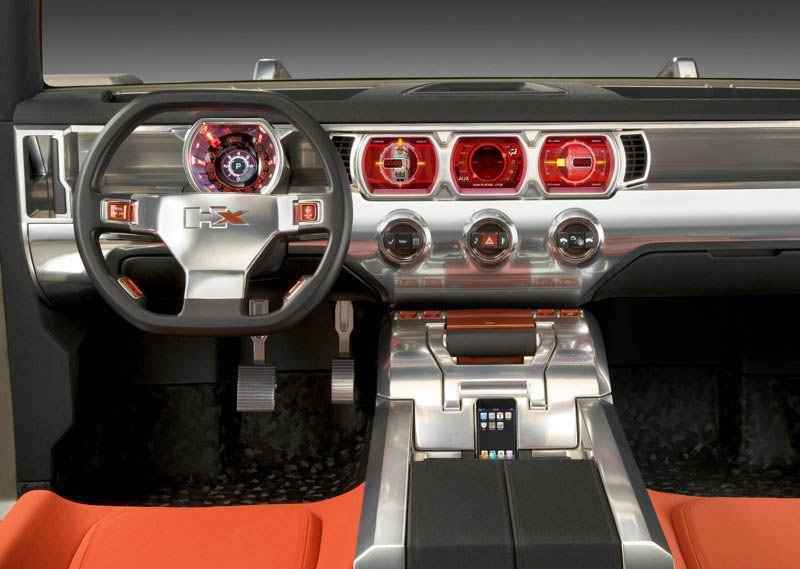
Furthering the aeronautical influence is the instrument panel, which uses an exposed, extruded aluminum cross-vehicle beam as its foundation. On the beam, the instrument cluster and other vital controls are mounted; and it also features a unique, removal top cover that provides significant storage capability.
 
Seating and console details
Like aircraft seats, the HX's seats are constructed on a lightweight framework with minimal components that feature lightening holes and strength-enhancing cross braces or triangulations. They are mounted on exposed, aircraft-style tracks and trimmed with a weather-resistant neoprene material.

The HX seats four, with a pair of bucket-type seats in the second row. The rear seats mimic the front seats' design and can be removed to generate more cargo room. All the seats feature a four-point, racing-style safety harness.

The inner seat track on both front seats is located beneath the outer edges of a prominent center console. The console offers exceptional storage capability and houses a unique shifter that mounts low and out of the way when the vehicle is parked - also hiding from sight the engine starter button. It has a spring-loaded cover that pops up when the driver is ready to select a gear.

The console  houses a resting place for phones, MP3 player and iPods or iPhones. In fact, there is no conventional radio in the HX, only integrated speakers. Passengers plug in an iPod, or similar device, to a USB connector to play music in the HX.

Gauges and tools

The "cut-off circles" motif of the exterior is seen even more so on the HX's interior, as the gauge cluster, instrument panel vents and even the steering wheel carry the design element.

A three-element gauge cluster - each of the three instrument "pods" carries the cut-off circle design - delivers crucial driver information in either a highway or off-road mode. This conceptual reconfigurable gauge layout uses LCD screens with multiple layouts, including a navigation system. The nav system features GPS and compass information; and is designed to upload trail information before setting off on an excursion.

The center gauge pod houses a speedometer and tachometer, but changes to a wheel angle indicator when the transmission is in the low position. This off-road mode changeover from the highway mode gives the driver information that is more pertinent to the driver conditions. The trail view of a camera mounted in the rear-view mirror can be displayed on the instrument panel, too.

The off-road mode features of the instrument panel comprise the virtual tools of the HX, while others are mounted for physical use, including a folding shovel, flashlight and first-aid kit. They all carry the "clipped circle" design motif found throughout the vehicle.

Ready for rocks, trails and more

With its compact dimensions, almost no overhangs and grippy 35-inch tires, the HX is ready for all terrains. Like all HUMMER production models, the HX has sturdy, body-on-frame construction, onto which is mounted front and rear independent suspensions.

The front suspension features an electronic-disconnecting stabilizer bar for enhanced maneuverability when driving off road, and the rear suspension is located with Computer Numerical Controlled (CNC)-machined, billet trailing arms. Heavy-duty shocks with piggyback reservoirs were custom-made for the HX by renowned racing shock manufacturer Fox; one is mounted at each wheel position.

A full-time 4WD system pulls the HX over, through and around off-road obstacles. It transfers torque to the front and rear axles, each of which is equipped with a locking differential. The torque meets the trail via custom 35-inch-tall off-road tires that are mounted on a set of custom, bead-lock-style wheels that have a two-tone appearance; dark-painted wheel centers complemented by silver-anodized outer rims.

A complete underbody armor kit, including a front skid plate, powetrain protection and more, protects the HX from wayward rocks and other potentially damaging objects. A power-operated winch is located in the front bumper, and the HX has recovery hooks mounted on the front and rear bumpers, just in case its help is required for wrangling others out of unfortunate off-road situations.

Motivation for the HX comes from an E85 FlexFuel 3.6L SIDI V-6 that is backed by a six-speed automatic transmission. The transmission is teamed with the 4WD system to offer exceptional low-speed traction and crawling capability. Four-wheel-disc brakes provide confident stopping power.

SPECIFICATIONS
  • Body style / driveline: two-door, four-seat open-top, four wheel-drive
  • Construction: welded steel frame, electro galvanized steel
  • Engine type: 3.6L V-6 VVT (variable valve timing) with spark-ignition, direct injection
  • Displacement (cu in / cc): 217 / 3564
  • Bore & stroke (in / mm): 3.70 x 3.37 / 94 x 85.6
  • Block material: sand-cast aluminum with cast-in bore liners
  • Cylinder head material: cast aluminum
  • Valvetrain: DOHC, 4 valves per cylinder, variable valve timing (VVT)
  • Fuel delivery: direct high-pressure fuel injection
  • Compression ratio: 11.3:1
  • Horsepower (hp / kW @ rpm): 304 / 227 @ 6300 rpm (est)
  • Torque (lb.-ft. / Nm @ rpm): 273 / 370 @ 5200 rpm (est)
  • Fuel Type: unleaded regular or E85 ethanol
  • Transmission: Hydra-Matic 6L50 six-speed electronically control automatic transmission
  • Suspension:
          o front: independent SLA, custom Fox Racing coil-over shocks; 2-in shocks, 2.5-in springs
          o rear: semi-trailing link, custom Fox Racing coil-over shocks; 2-in shocks, 2.5-in springs
  • Wheel travel (in / mm):
          o front: 9 / 228
          o rear: 11/ 279
  • Brakes: four-wheel disc; Brembo 6-piston calipers (front); Brembo 4-piston calipers (rear)
  • Rotor diameter x thickness (in / mm): 15 x 1.25 / 381 x 31.75
  • Wheel size & type: 20-inch x 9-inch
  • Tires: 35-inch custom Bridgestone Dueler
  • Wheelbase (in / mm): 103 / 2616
  • Overall length: 171 / 4343
  • Overall width (in / mm): 81 / 2057
  • Overall height (in / mm): 72 / 1829
  • Track (in / mm): 67 / 1702 (front); 68 / 1727 (rear)
  • Minimum ground clearance front (in / mm): 13 / 320
  • Approach angle (degrees): 56
  • Departure angle (degrees): 51
  • Breakover angle (degrees): 25
  • Grade capability (percent): 60
  • Side slope capability (percent): 40
  • Water fording capability (in / mm): 24 / 610 (at 5 mph)
  • Seating capacity: 4